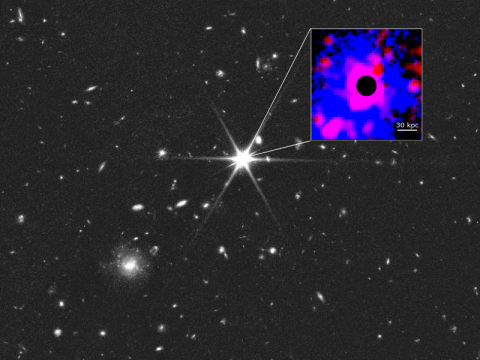
In the local Universe, large galaxy clusters are immersed in vast, dense “atmospheres” of extremely hot gas, with temperatures of tens of millions of kelvin, known as the intracluster medium (ICM). By contrast, when observing the more distant and ancient Universe, telescopes have so far almost always detected only the cold-gas component. Now, a study published in Astronomy & Astrophysics reveals, for the first time and with clarity, the precise moment when this vast hot atmosphere begins to form, when the Universe was only a fraction of its current age.
The discovery was made by analysing 634,000 seconds, approximately 180 hours, of data from NASA’s Chandra X-ray Space Telescope. The research, led by Andrea Travascio, a researcher at the Italian National Institute for Astrophysics (INAF), and Sebastiano Cantalupo, Professor of Astrophysics at the University of Milano-Bicocca, identified a structure of extremely hot and dense gas extending for approximately 100,000 light-years around a quasar, the extremely bright and active nucleus of a very distant galaxy, located at the centre of the enormous MQN01 protocluster, an aggregation of galaxies still in the process of formation dating back to when the Universe was approximately two billion years old.